
Greater Austin Backyard
Planning Guide
How to Choose the Right Bounce House or Water Slide for Your Greater Austin Yard
Not sure if that water slide will fit? Worried about your sloped lot or those big Live Oaks? This guide helps Greater Austin families measure, plan, and choose the perfect party rental for their specific space.
Quick Measurement Guide
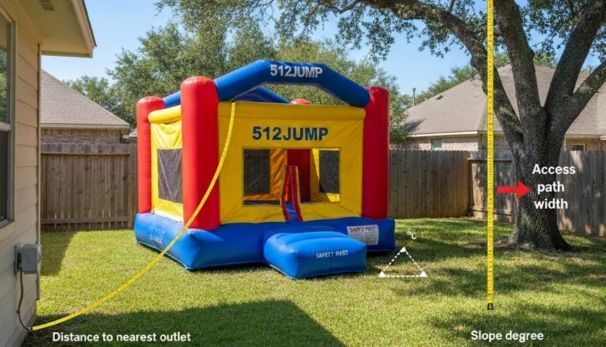
What You Need to Measure
Before browsing rentals, grab a tape measure and note:
- Available space dimensions (length × width in feet)
- Overhead clearance (height to lowest branch, power line, or structure)
- Access path width (side gate, walkway from driveway to backyard)
- Slope degree (use smartphone level app - free)
- Distance to nearest outlet (for inflatables requiring power)
Pro tip: Take photos of your space from multiple angles and text them to 512Jump - we can recommend equipment before you spend time measuring.
Standard Equipment Sizes
Bounce Houses
| Size Category | Footprint | Setup Space Needed | Overhead | Best For |
|---|---|---|---|---|
| Small | 13' × 13' | 16' × 16' | 12' | Toddler parties, tight yards, 4-6 kids |
| Medium | 15' × 15' | 18' × 18' | 14' | School-age parties, 6-8 kids |
| Large | 20' × 20' | 23' × 23' | 15' | Big groups, 8-10 kids, spacious yards |
| XL Combo | 25' × 18' | 28' × 21' | 16' | Combined bounce/slide, 10-12 kids |
Water Slides
| Size Category | Footprint | Setup Space Needed | Overhead | Landing Pool | Best For |
|---|---|---|---|---|---|
| Small Slide | 18' × 10' | 21' × 13' | 12' | 4' × 6' | Ages 2-6, compact yards |
| Medium Slide | 24' × 12' | 27' × 15' | 14' | 6' × 8' | Ages 5-12, standard yards |
| Tall Slide | 28' × 14' | 31' × 17' | 18' | 8' × 10' | Ages 7+, larger properties |
| Dual Lane | 30' × 18' | 33' × 21' | 16' | 10' × 12' | Racing, high-traffic parties |
Combo Units
| Type | Footprint | Setup Space Needed | Features |
|---|---|---|---|
| Bounce + Slide | 25' × 15' | 28' × 18' | Dry bounce area + attached slide |
| Wet/Dry Combo | 22' × 18' | 25' × 21' | Works as bounce house or water slide |
| Obstacle Course | 35' × 12' | 38' × 15' | Linear layout, great for narrow yards |
Why extra space? The "setup space needed" includes required 3-foot safety clearance on all sides, anchoring stakes/sandbags, and blower placement.
Typical Greater Austin Yard Sizes
By Neighborhood Type
Urban Austin (Clarksville, Hyde Park, Travis Heights)
- Typical lot: 5,000-7,000 sq ft
- Backyard usable space: 20' × 25' average
- Best fits: Small bounce houses, compact water slides, vertical combos
Suburban (Round Rock, Cedar Park, Pflugerville)
- Typical lot: 7,000-10,000 sq ft
- Backyard usable space: 30' × 40' average
- Best fits: Medium-large bounce houses, standard water slides, most combos
Acreage (Leander, Dripping Springs, Lakeway)
- Typical lot: 1+ acres
- Backyard usable space: 40' × 60'+
- Best fits: Any equipment, multiple units, obstacle courses
Townhomes/Zero-lot:
- Typical lot: 2,000-4,000 sq ft
- Backyard usable space: 15' × 20' average
- Best fits: Small bounce houses only, or consider community common area
Common Austin Lot Challenges
Live Oak trees
Beautiful but space-eating. Mature trees can have 40-60 foot canopies. Equipment must go:
- Minimum 15 feet below lowest branch
- Outside the drip line for anchoring access
- Where falling acorns/branches won't damage equipment
Sloped terrain
Central Texas limestone creates natural slopes.
- Less than 5-degree slope: Most equipment works
- 5-10 degree slope: Limited options, sandbag anchoring
- More than 10 degrees: Usually unsuitable without leveling
Pool placement
Equipment must stay minimum 10 feet from pool edge (liability and anchoring). Consider:
- Pool equipment access
- Splash-out zones
- Fence gate swing clearance
Space Planning Layouts
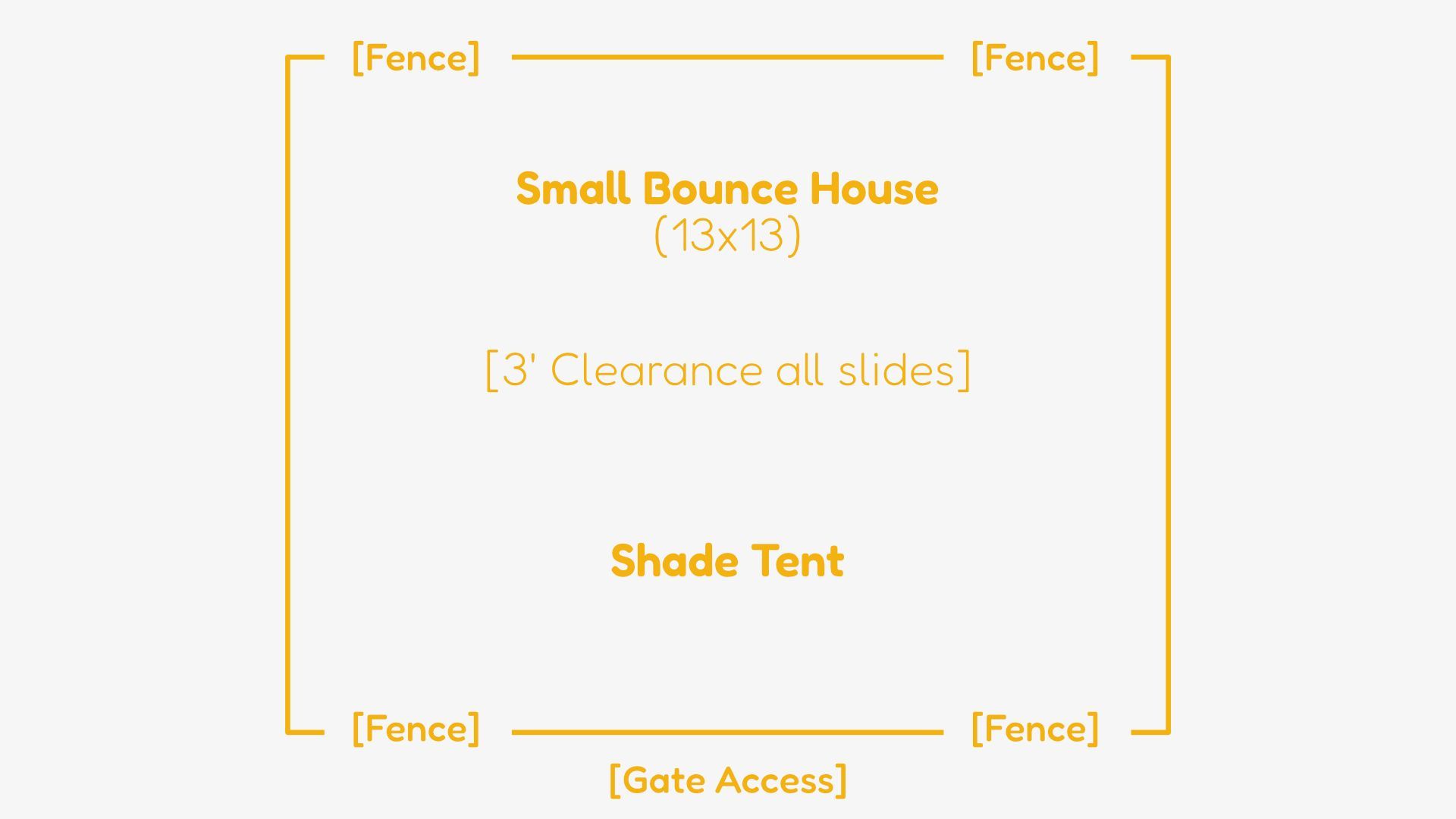
Small Urban Yard (20' × 25')
Works well: One small bounce house OR one small water slide
Traffic flow: Keep path from gate to house clear
Shade solution: Pop-up tent adjacent to equipment
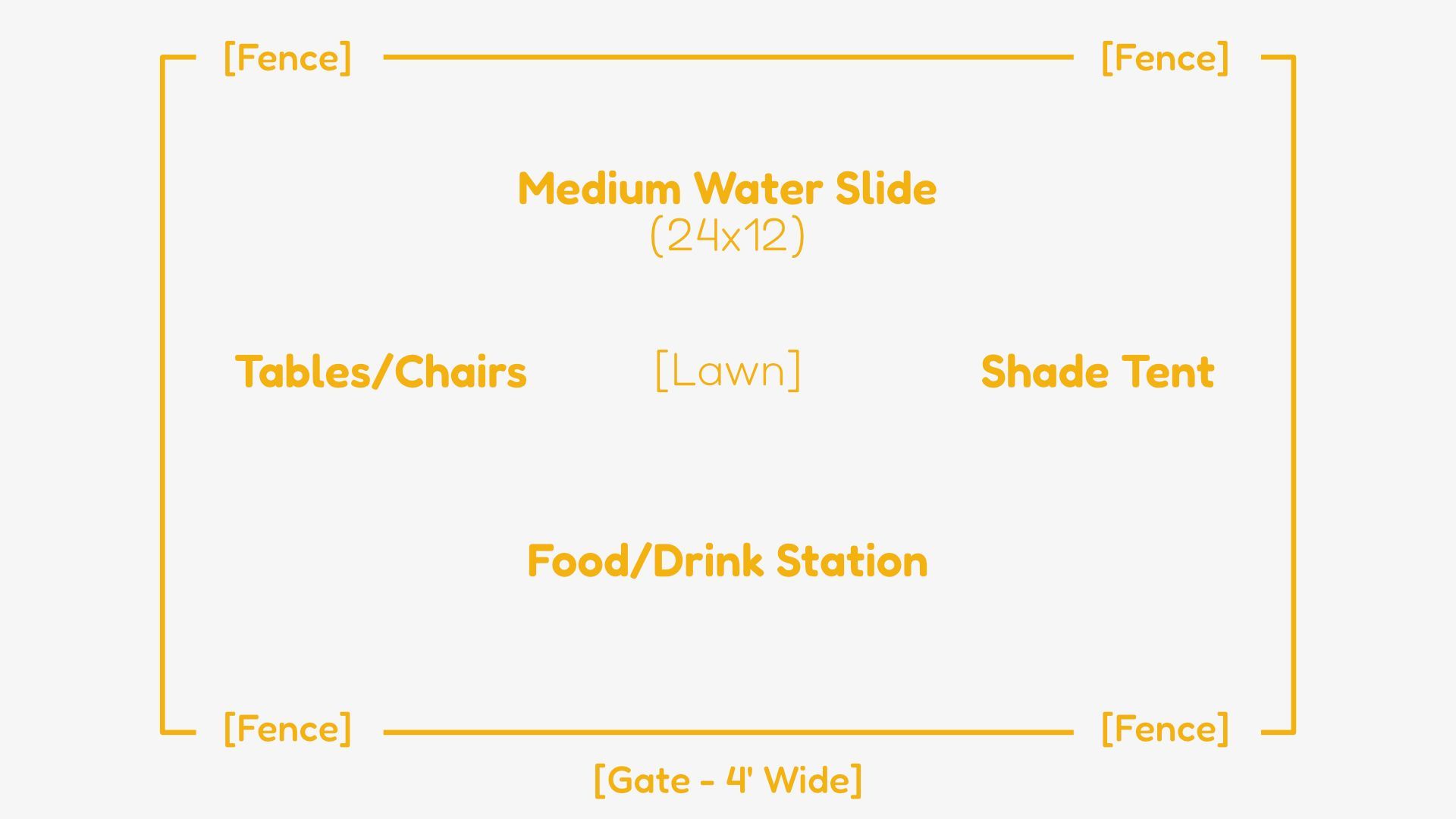
Standard Suburban Yard (30' × 40')
Works well: One medium-large bounce house, one medium water slide, OR one combo unit
Traffic flow: Leave 6-foot pathway from gate to party area
Multiple zones: Separate wet and dry activities
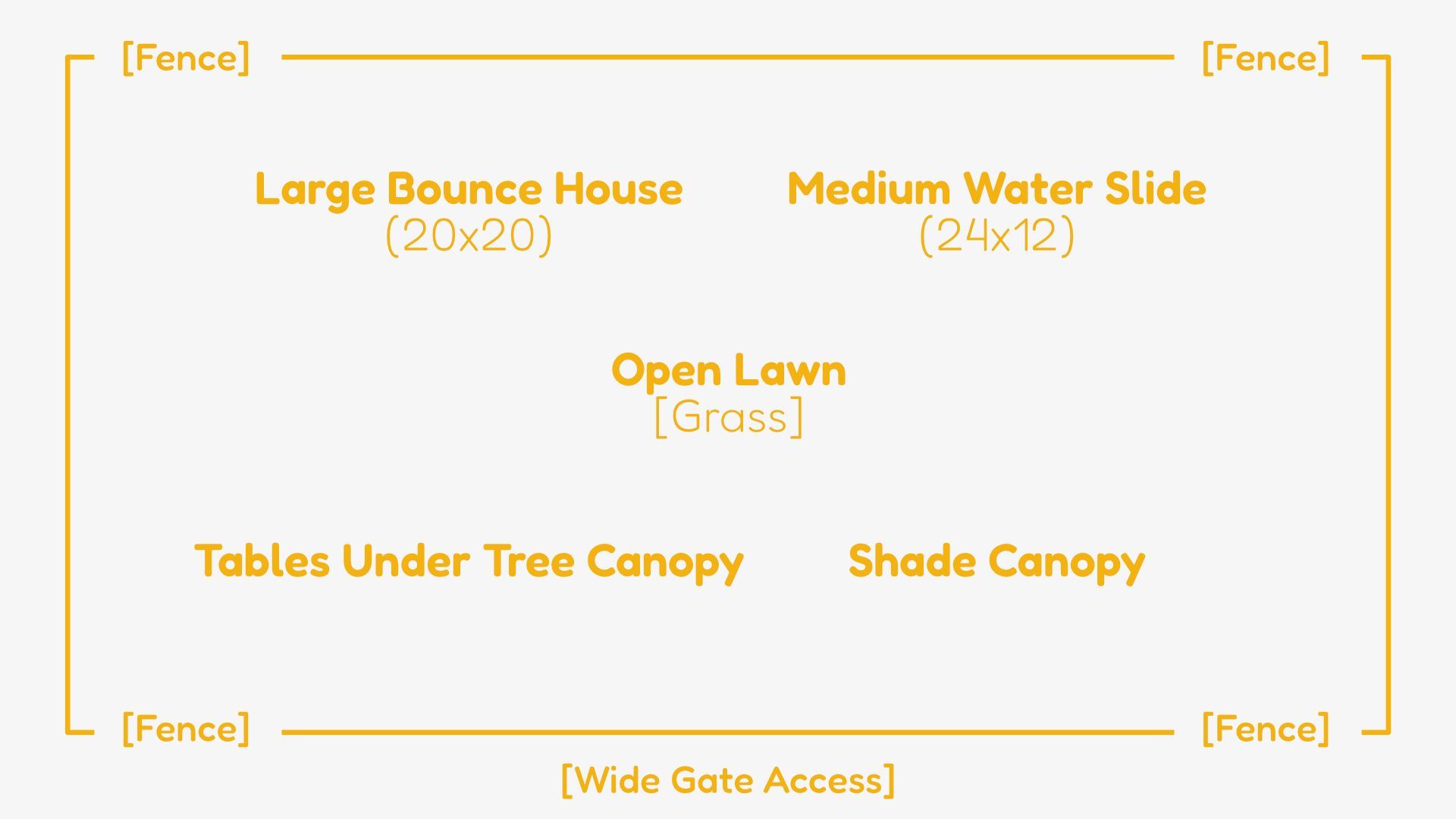
Large Lot Layout (50' × 60')
Works well: Multiple units, obstacle courses, dual activities
Zoning: Separate age groups by equipment location
Natural shade: Utilize tree coverage for seating areas
Access Requirements
Getting Equipment to Your Backyard
Equipment must travel from delivery truck to setup location.
Minimum access path width:
3 feet
Small bounce houses
4 feet
Medium units
5 feet
Large units/water slides
6 feet
Obstacle courses
Common Austin access issues:
Side gates
Most Greater Austin homes have 3-4 foot gates
- Measure actual opening (not gate width - check clearance when fully open)
- Check for gate post obstructions, handles, locks
- Verify gate can stay open during setup (30-45 minutes)
Through the house
If backyard only accessible through home
- Must have clear path at least 4 feet wide
- Remove breakables from hallways
- Protect flooring (512Jump provides floor runners)
- May incur additional setup time/fee
Townhome/condo shared paths
- Verify HOA allows equipment transport through common areas
- Check for stairs, tight turns, or narrow passages
- May need special permission for delivery vehicle parking
Driveway to Backyard Distance
Standard service
Up to 100 feet from truck parking to setup
Extended carry
100-200 feet may incur additional fee
Challenging access
Stairs, gravel paths, or extremely tight clearances require advance discussion
Terrain & Ground Surface
Ideal Setup Surfaces
Best
Established grass lawn
- Allows proper stake anchoring
- Cushions jumps and falls
- Typical of Greater Austin yards
Good
Dirt or mixed grass/dirt
- Common in new construction (Leander, Hutto developments)
- Anchoring works well
- Consider grass seed after event to repair high-traffic areas
Challenging
Rocky or limestone-heavy soil
- Common in Westlake, west Austin hill country
- May require sandbag anchoring instead of stakes
- 512Jump assesses on delivery - always works, just different method
Not Suitable
Gravel, concrete, asphalt
- Cannot properly anchor
- Safety concern (hard landing surface)
- Rare exceptions with extensive sandbag weighting
Slope Assessment
Use free smartphone level app to measure:
0-3 degrees
Perfect - no concerns
3-5 degrees
Acceptable for most equipment
5-8 degrees
Limited equipment options, requires assessment
8+ degrees
Usually unsuitable without professional leveling
Austin slope patterns
West Austin/hill country
Often 5-10+ degree slopes
East Austin
Generally flatter, 0-3 degrees
North (Round Rock, Pflugerville)
Mixed, 2-5 degrees typical
South (Buda, Kyle)
Rolling, 3-7 degrees common
Drainage Considerations
Water slides need good drainage:
- Avoid low spots that pool water
- Clay soil (common in Round Rock, Georgetown) drains slowly
- Limestone (west Austin) drains quickly
- Plan for 50-100 gallons water runoff during use
Post-event lawn care:
- Water-saturated areas may show wear
- High-traffic zones may need reseeding
- Usually recovers within 2-3 weeks with watering
Overhead Clearance
What to Measure
Equipment needs clear vertical space. Check for:
Natural obstacles:
- Tree branches (especially Live Oak, Cedar Elm)
- Spanish moss hanging from trees (east Austin)
- Overhanging shrubs or vines
Artificial obstacles:
- Power lines (most Austin neighborhoods: 15-20 feet high)
- Phone/cable lines (typically lower, 10-15 feet)
- Eaves, awnings, or pergolas
- Basketball hoops or play structures
Minimum Clearances Needed
| Equipment Type | Overhead Clearance Required |
|---|---|
| Small bounce house | 12 feet |
| Medium bounce house | 14 feet |
| Large bounce house | 15 feet |
| Small water slide | 12 feet |
| Medium water slide | 14 feet |
| Tall water slide | 18 feet |
| Combo units | 16 feet |
Safety note: Measured from ground to lowest point of obstacle, not to trunk or pole.
Power Line Safety
If equipment would be within 10 feet horizontally of power lines:
- Contact 512Jump before booking
- May need alternate placement
- Never risk electrocution for party convenience
Austin Energy requires 15-foot clearance from primary lines (the thicker cables on top).
Electrical & Water Access
Power Requirements
Inflatables need continuous power:
- Standard 110V household outlet
- 15-amp dedicated circuit preferred
- Within 50 feet of setup location (we provide extension cords up to 50')
Circuit capacity:
- Blower motor: 10-12 amps continuous
- Don't share circuit with pool pump, outdoor kitchen, or AC unit
- If breaker trips during party, blower stops (equipment deflates)
Austin-specific electrical:
- GFCI outlets common in newer homes (post-2008 construction) - these work fine
- Outdoor outlets required by code in Travis/Williamson counties
- If only indoor outlets available, route cord through window/door
Water Access (for slides)
Requirements:
- Standard garden hose connection
- Must reach setup location
- Greater Austin water pressure (typically 50-80 PSI) works perfectly
Water slide consumption:
- Continuous flow at low volume (similar to sprinkler)
- Approximately 5-8 gallons per minute
- 3-hour party: ~1,000-1,500 gallons total
Drought restriction compliance:
- Stage 1: Outdoor water use allowed any day (covers party rentals)
- Stage 2+: Contact Austin Water before booking summer events
- Water slides typically exempted as "special event" under 512Jump commercial permit
Multi-Unit Layouts
Two-Equipment Setups
When renting multiple pieces, plan zones:
Wet + Dry zones:
- Water slide in full sun (heats water naturally)
- Bounce house in shade (cooler for kids)
- Minimum 10 feet between units
Age separation:
- Toddler bounce house on one side of yard
- Older kid slide on opposite side
- Parent supervision easier with visual separation
Activity rotation:
- Obstacle course as "main event"
- Bounce house as "cool down" area
- Prevents bottlenecks
Power Planning for Multiple Units
Each unit needs separate circuit:
- Two units = two different outlets on different breakers
- Check your electrical panel if unsure
- 512Jump can advise during booking
Neighborhood-Specific Considerations
Steiner Ranch / Lakeway
- Terrain: Hilly, limestone-heavy, mature trees
- HOA: Often requires advance approval, aesthetic standards
- Access: Many homes on cul-de-sacs, winding driveways
- Best equipment: Medium units, sandbag anchoring common
Round Rock / Pflugerville
- Terrain: Flat to gently rolling, clay soil, newer landscaping
- HOA: Moderate restrictions, noise considerations
- Access: Wide side gates typical in newer builds
- Best equipment: All sizes work well, excellent drainage
Central Austin (78704, 78701, 78751)
- Terrain: Flat, established trees, compact lots
- HOA: Minimal (older neighborhoods), parking concerns
- Access: Narrow gates, alley access common
- Best equipment: Small to medium units, vertical orientation
Cedar Park / Leander
- Terrain: Mixed, new developments flatter, older areas rolling
- HOA: Varies widely, check rules
- Access: Usually good, wide lots
- Best equipment: Full range, excellent for large events
Dripping Springs / Wimberley
- Terrain: Steep slopes, heavy tree coverage, rocky
- HOA: Minimal or none
- Access: Long driveways, rural
- Best equipment: Large units work if flat areas exist, site visit recommended
When renting multiple pieces, plan zones:
Special Situations
Party at a Park
Greater Austin parks that allow rentals:
- Austin Parks & Recreation: 14-day permit required
- Round Rock parks: Event permit + insurance certificate
- Cedar Park: Recreation rental permit
- Pflugerville: Special event application
Space considerations:
- Most parks require 50+ feet from playground equipment
- Electrical: Bring portable generator (512Jump rents) or verify outlet access
- Water: Bring long hose or use park spigot (if permitted)
HOA Common Areas
Many Greater Austin neighborhoods have shared green spaces:
Book early
HOA common area reservations fill fast
Insurance
Most require certificate from rental company (512Jump provides)
Rules
Check noise, setup hours, parking restrictions
Electrical
May require generator rental
Apartment/Townhome Complex
Courtyard parties:
- Property manager approval required (typically 30 days advance)
- Liability insurance proof (512Jump provides)
- Access challenges common (stairs, elevators, locked gates)
- Noise restrictions stricter
Still Not Sure What Fits?
Before finalizing your rental:
- Measured available space (length × width × height)
- Verified access path width from street to setup location
- Located electrical outlet within 50 feet OR arranged generator rental
- Checked water hose reaches setup location (for slides)
- Reviewed HOA rules (if applicable)
- Assessed slope using smartphone level app
- Identified overhead obstacles (trees, power lines)
- Noted ground surface type (grass, dirt, rock)
- Planned equipment placement away from pool, fence, structures
- Confirmed adults available for supervision
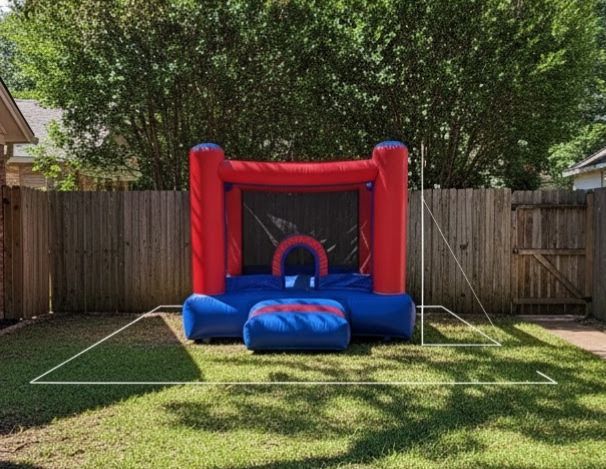
Still Not Sure What Fits?
Text us photos of your space:
Include yard dimensions and setup location preference
Schedule a site visit:
For complex layouts, steep slopes, or multi-unit events
Virtual consultation:
Video call to walk through your space together
Try our online space calculator:
512jump.com/space-planner (interactive tool)
Greater Austin families have trusted 512Jump for thousands of backyard parties. We've seen every yard challenge the region can offer - from Westlake limestone to Pflugerville clay to downtown Austin micro-lots. Contact us to discuss your specific space and find the perfect fit for your celebration.
Last updated: October 2025 | Greater Austin party rental planning guide